The water clock worked by having water poured into
Thursday, 28 March 2019
Water Clock Korea 'Jagyeongnu'
The water clock worked by having water poured into

Olafur Eliasson:The illusion of stopped movement and time--within an artwork that incorporates actual movement and time

In a darkened room, there is a pool of water on the floor and water dripping from the ceiling into the pool. This is what you know when you step into the room. But it is lit only with strobe light, so all you have are flashes of information as to what you are seeing. The strobe light freezes the movement of the water drops, in an endless variation. It is like seeing time stopped. The effect is mesmerizing and magical. Along with the slight coolness of the room and the scent of cool fresh water, it becomes a transcendent moment.
Definition of 'Hertz'
The hertz is defined as one cycle per second. The International Committee for Weights and Measures defined the second as "the duration of 9 192 631 770 periods of the radiation corresponding to the transition between the two hyperfine levels of the ground state of the caesium 133 atom"[2][3] and then adds: "It follows that the hyperfine splitting in the ground state of the caesium 133 atom is exactly 9 192 631 770 hertz, ν( hfs Cs) = 9 192 631 770 Hz." The dimension of the unit hertz is 1/time (1/T). Expressed in base SI units it is 1/second (1/s).
In English, "hertz" is also used as the plural form.[4] As an SI unit, Hz can be prefixed; commonly used multiples are kHz (kilohertz, 103 Hz), MHz (megahertz, 106 Hz), GHz (gigahertz, 109 Hz) and THz (terahertz, 1012 Hz). One hertz simply means "one cycle per second" (typically that which is being counted is a complete cycle); 100 Hz means "one hundred cycles per second", and so on. The unit may be applied to any periodic event—for example, a clock might be said to tick at 1 Hz, or a human heart might be said to beat at 1.2 Hz. The occurrence rate of aperiodic or stochastic events is expressed in reciprocal second or inverse second (1/s or s −1) in general or, in the specific case of radioactive decay, in becquerels .[5] Whereas 1 Hz is 1 cycle per second, 1 Bq is 1 aperiodic radionuclide event per second.
헤르츠 (hertz, 기호: ㎐, 문화어: 헤르쯔)는 SI 단위계의 주파수 단위이다. 이 이름은 전자기학 분야에서 업적을 남긴 독일 물리학자 하인리히 루돌프 헤르츠(Heinrich Rudolf Hertz)를 기리기 위한 것이다.
1 ㎐는 SI 기본 단위로 표현하면 1 s이다. 1 Hz는 “1초에 한 번”을 의미한다. 즉 100 Hz는 1초에 100번을 반복 혹은 진동함을 뜻한다. 이 단위는 모든 주기적으로 반복되는 것에 쓰일 수 있다. 매우 간단한 예로 정확히 맞는 시계의 초침은 1 Hz로 똑딱거린다.


Electromagnetic radiation is often described by its frequency—the number of oscillations of the perpendicular electric and magnetic fields per second—expressed in hertz.
Radio frequency radiation is usually measured in kilohertz (kHz), megahertz (MHz), or gigahertz (GHz). Light is electromagnetic radiation that is even higher in frequency, and has frequencies in the range of tens (infrared) to thousands (ultraviolet) of terahertz. Electromagnetic radiatio n with frequencies in the low terahertz range (intermediate betwe en those of the highest normally usable radio frequencies and long-wave in frared light) is often called terahertz radiation. Even higher frequencies exist, such as that of gamma rays, whi ch can be measured in exahertz (EHz). (For historical reasons, the frequencies of light and higher frequency electromagnetic radiation are more commonly specified in terms of their wavelengths or photon energies.
Thursday, 21 March 2019
Definition of 'Chronophotography'
Chronophotography is an antique photographic technique from the Victorian era (beginning about 1867–68), which captures movement in several frames of print. These prints can be subsequently arranged either like animation cels or layered in a single frame. It is a predecessor to cinematography and moving film, involving a series of different cameras, originally created and used for the scientific study of movement.

Chronophotography is defined as "a set of photographs of a moving object, taken for the purpose of recording and exhibiting successive phases of motion".[2] The term chronophotography was coined by French physiologist Étienne-Jules Marey to describe photographs of movement from which measurements could be taken and motion could be studied. It is derived from the Greek word χρόνος chrónos ("time") combined with photography.

Chronophotography is defined as "a set of photographs of a moving object, taken for the purpose of recording and exhibiting successive phases of motion".[2] The term chronophotography was coined by French physiologist Étienne-Jules Marey to describe photographs of movement from which measurements could be taken and motion could be studied. It is derived from the Greek word χρόνος chrónos ("time") combined with photography.
Sunday, 17 March 2019
Reseach of 'Pioneering Nineteenth-Century Motion Photography by French Scientist Étienne-Jules Marey'
French scientist Étienne-Jules Marey(March 5, 1830–May 21, 1904) made significant contributions to the development of cardiology and physical instrumentation in medicine, but he is best-known as a pioneer of chronophotography — an antique Victorian-era photographic technique that captures several sequential frames of movement, which can then be combined into a single image. In 1882, Marey invented a chronophotographic gun that was capable of taking 12 consecutive frames per second, recorded on the same picture. He used these pictures to study the gallop of horses, the flight of birds, the gait of elephants, the swim of fish, and the organic motion of many more creatures, and his work served as the foundation for Eadweard Muybridge‘s iconic animal locomotion studies and directly influenced the development of early cinema. Yet the background of his landmark images remains obscure.

Etienne-Jules Marey: A Passion for the Trace (public library) tells the extraordinary story of a man whose many interests and talents — scientist, physician, aviation researcher, motion studies pioneer and prolific inventor — are a living testament to our founding philosophy of cross-disciplinary curiosity as the root of creativity. This English translation by Robert Galeta is based on the writing of French philosopher of science Francois Dagognet, originally published in 1992.


Etienne-Jules Marey: A Passion for the Trace (public library) tells the extraordinary story of a man whose many interests and talents — scientist, physician, aviation researcher, motion studies pioneer and prolific inventor — are a living testament to our founding philosophy of cross-disciplinary curiosity as the root of creativity. This English translation by Robert Galeta is based on the writing of French philosopher of science Francois Dagognet, originally published in 1992.

Definition of 'Rolling Shutter'
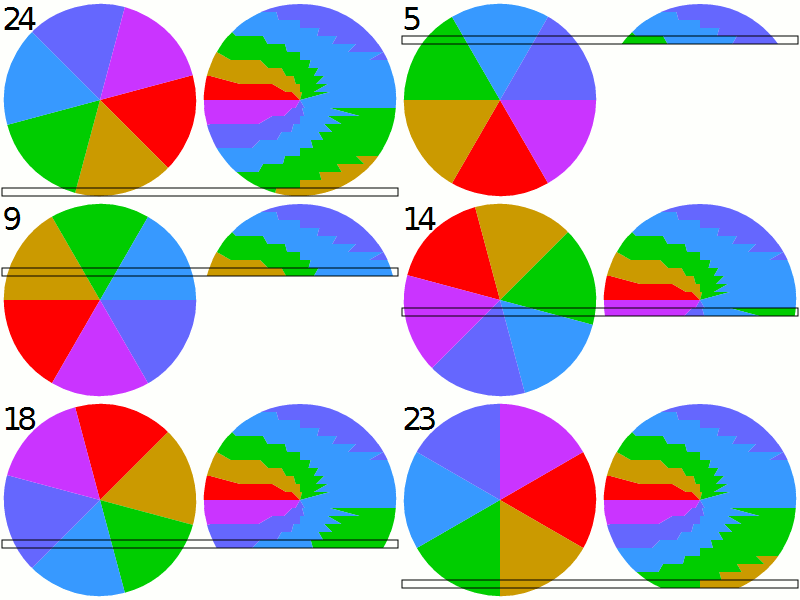
Rolling shutter is a method of image capture in which a still picture (in a still camera) or each frame of a video (in a video camera) is captured not by taking a snapshot of the entire scene at a single instant in time but rather by scanning across the scene rapidly, either vertically or horizontally. In other words, not all parts of the image of the scene are recorded at exactly the same instant. (Though, during playback, the entire image of the scene is displayed at once, as if it represents a single instant in time.) This produces predictable distortions of fast-moving objects or rapid flashes of light. This is in contrast with "global shutter" in which the entire frame is captured at the same instant.
The "rolling shutter" can be either mechanical or electronic.[1][2] The advantage of this method is that the image sensor can continue to gather photons during the acquisition process, thus effectively increasing sensitivity. It is found on many digital still and video cameras using CMOS sensors. The effect is most noticeable when imaging extreme conditions of motion or the fast flashing of light. While some CMOS sensors use a global shutter,[3] the majority found in the consumer market use a rolling shutter.
CCDs (charge-coupled devices) are alternatives to CMOS sensors, which are generally more sensitive and more expensive. CCD-based cameras often use global shutters, which take a snapshot representing a single instant in time and therefore do not suffer from the motion artifacts caused by rolling shutters.[4]
Definition of 'Optical phenomena'
Optical phenomena are any observable events that result from the interaction of light and matter. See also list of optical topics and optics. A mirage is an example of an optical phenomenon.
Common optical phenomena are often due to the interaction of light from the sun or moon with the atmosphere, clouds, water, dust, and other particulates. One common example is the rainbow, when light from the sun is reflected and refracted by water droplets. Some, such as the green ray, are so rare they are sometimes thought to be mythical.[1] Others, such as Fata Morganas, are commonplace in favored locations.
Other phenomena are simply interesting aspects of optics, or optical effects. For instance, the colors generated by a prism are often shown in classrooms.
Optical phenomena include those arising from the optical properties of the atmosphere; the rest of nature (other phenomena); of objects, whether natural or human-made (optical effects); and of our eyes (Entoptic phenomena). Also listed here are unexplained phenomena that could have an optical explanation and "optical illusions" for which optical explanations have been excluded.
There are many phenomena that result from either the particle or the wave nature of light. Some are quite subtle and observable only by precise measurement using scientific instruments. One famous observation is of the bending of light from a star by the Sun observed during a solar eclipse. This demonstrates that space is curved, as the theory of relativity predicts.
Subscribe to:
Posts (Atom)